About once a quarter, someone in a leadership meeting asks me to settle the hybrid vs multi-cloud question once and for all. It usually comes up the way people ask about paint colors, as if there are two swatches on the table and we only need to pick one. I understand why, because vendors sell these as products and analysts publish them as categories. After close to two decades designing infrastructure for professional services firms, consultancies and the occasional stubborn manufacturer, though, I’ve stopped answering that question the way it’s asked.
Hybrid cloud and multi-cloud aren’t opposites. Instead, they answer different questions, they solve different problems, and plenty of organizations end up running both whether they planned to or not. So when you weigh hybrid cloud vs multi-cloud, the useful question isn’t which one is better. Rather, it’s which problem you actually have, and how much complexity you’re willing to pay to solve it.
This piece is how I walk clients through the hybrid vs multi-cloud decision. It isn’t a vendor pitch, and it isn’t a glossary either. In short, it’s the thinking I’d give you if we were standing at a whiteboard together.
The Short Answer on Hybrid vs Multi-Cloud
If you only read one paragraph, read this one.
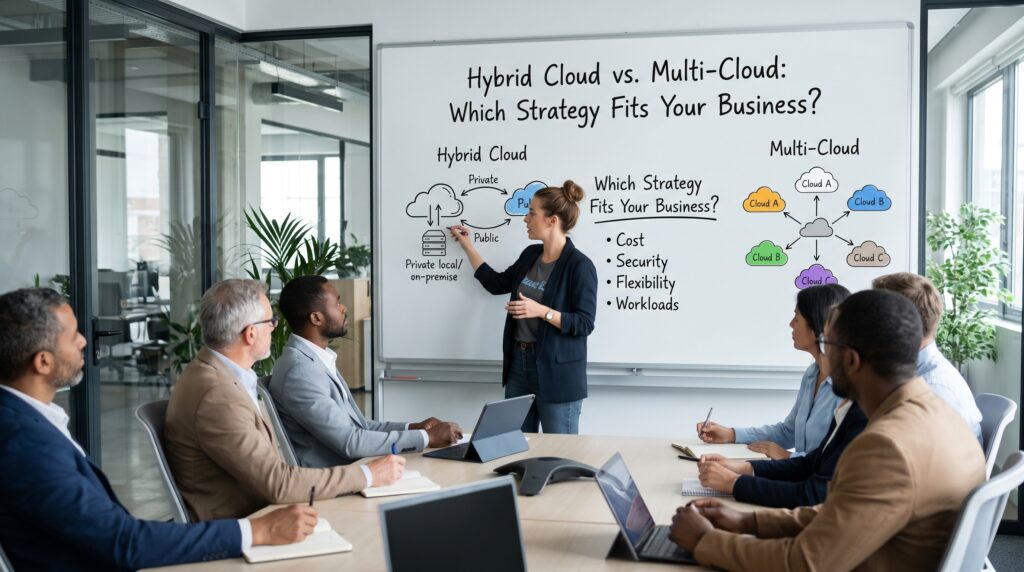
Hybrid cloud is about where your workloads live. In other words, you keep some infrastructure you control, such as your own data center, a colocation cage or a private cloud, and you connect it to public cloud in a way that lets the two operate as one estate.
Multi-cloud, on the other hand, is about who you buy from. You use two or more public cloud providers, on purpose or by accident.
Put simply, hybrid is a decision about control and location, whereas multi-cloud is a decision about suppliers and leverage. As a result, you can have one, the other, both, or neither. Most mid-size and large businesses I work with have both, yet they only manage one of them well.
What Hybrid Cloud Actually Means
The formal definition comes from NIST, the U.S. standards body. It describes a hybrid cloud as a composition of two or more distinct cloud infrastructures that stay unique entities but are bound together by technology that lets data and applications move between them. That definition dates back to 2011, and the important word in it is “bound.”
In practice, however, a lot of companies call themselves hybrid simply because they have a data center and an AWS account. That’s not hybrid. Instead, that’s two separate environments that happen to share an invoice approver. A real hybrid architecture, by contrast, has shared plumbing:
- One identity system governing access to both sides.
- Private, predictable network connectivity between them, not just a VPN someone set up in a hurry three years ago.
- Consistent security policy and monitoring, so an alert in your data center and an alert in the cloud land on the same screen, whether that screen belongs to your own team or a managed detection and response provider.
- A deliberate placement model, so the team knows why a workload lives where it lives.
Without those four things, you don’t have a hybrid cloud. Instead, you have two islands and a ferry schedule.
For example, the classic hybrid pattern I see in professional services looks like this: client document repositories, billing systems and anything bound by confidentiality agreements stay on infrastructure the firm controls, while collaboration tools, analytics, burst compute and customer-facing portals run in public cloud. In this way, the private side holds what has to stay put. Meanwhile, the public side holds what needs to move quickly.
What Multi-Cloud Actually Means
Multi-cloud simply means using more than one public cloud provider. For instance: AWS for your core platform, Azure because your identity and productivity suite already live in the Microsoft ecosystem, Google Cloud because the data science team fell in love with BigQuery. That’s multi-cloud.
Here’s the part the brochures leave out, though: most multi-cloud estates were never designed. Instead, they piled up. First, a business unit signs with a different provider. Then an acquisition brings its own cloud along. Finally, a developer spins up a proof of concept on whatever had free credits that month, and two years later it’s running payroll integrations.
The 2026 Flexera State of the Cloud Report says this plainly. Many organizations land in hybrid and multi-cloud environments through mergers and acquisitions, legacy decisions or siloed application choices, not because anyone sat down and designed it that way. Frankly, I’d put that finding on a poster in every IT department.
Accidental multi-cloud isn’t a strategy. Rather, it’s a situation. Therefore, the work is turning it into a strategy, or consolidating out of it.
Hybrid Cloud vs Multi-Cloud: The Differences That Matter in Practice
Comparison tables are everywhere, and most of them compare features. However, I’d rather compare consequences. These are the dimensions I actually weigh when I review a hybrid vs multi-cloud design.
What problem it solves. Hybrid solves for control: data residency, latency to physical operations, regulatory boundaries and protecting investments you’ve already made. Multi-cloud, by contrast, solves for choice: access to the best service for each job, negotiating leverage and reduced dependence on a single supplier.
Where the complexity lives. In hybrid, the complexity sits in the connection: networking, identity federation, data synchronization and keeping two very different operating models aligned. In multi-cloud, on the other hand, it sits in the duplication: two or three sets of APIs, security models, billing structures, certification paths and ways for things to fail.
How workloads relate to each other. Hybrid workloads tend to be tightly coupled. For example, an application in the cloud calls a database in your data center, often many times per transaction. Multi-cloud workloads, however, are usually loosely coupled, or should be. That is, each cloud runs a fairly complete system, and the systems talk through well-defined interfaces.
Cost Behavior and Skill Demands
How costs behave. Hybrid carries more upfront capital and steadier ongoing costs. Multi-cloud, meanwhile, is pure operating expense, but you lose some of the volume discounts you’d earn by committing all of your spend to one provider. In addition, you pay for data moving between clouds.
What skills it demands. Hybrid needs people who understand both traditional infrastructure and cloud-native operations. That combination is rarer than it sounds. Similarly, multi-cloud needs depth across several platforms at once, which most teams don’t have. In my experience, a team that’s excellent on one cloud and passable on a second is far more common than a team that’s genuinely strong on two.
What the Hybrid vs Multi-Cloud Numbers Say in 2026
It helps to know how common each model has become, mostly so nobody feels like an outlier.
Flexera’s 2026 report surveyed 753 cloud decision-makers. It found that 73% of organizations operate hybrid environments and 88% use multi-cloud. The figure that jumped out at me, though, is that only 14% run exclusively multi-cloud without any private cloud at all. In other words, pure public multi-cloud is the minority. Instead, the typical enterprise is a hybrid multi-cloud estate, and a third of respondents use multiple public and multiple private clouds at the same time, according to Flexera’s highlights from the 2026 report. So for most companies, the hybrid vs multi-cloud choice has already been made by circumstance.
That same research, as summarized by several analysts including Northdoor, also puts estimated waste in cloud spending at roughly 29%. I don’t think that’s a coincidence. After all, complexity that nobody designed tends to cost money that nobody can explain.
Meanwhile, the market keeps growing. Gartner projected that public cloud services spending would grow 21.3% in 2026 and reach $1.48 trillion by 2029, driven heavily by AI workloads. Consequently, more spend across more providers means the cost of getting this decision wrong keeps rising.
When Hybrid Cloud Is the Right Call
I recommend a deliberate hybrid architecture when one or more of these is true.
You have data that legally or contractually can’t go everywhere. Law firms, accounting practices, consultancies holding client financials, healthcare-adjacent businesses. Sometimes the constraint is regulatory. More often, however, in professional services, it’s a clause in a client agreement that says data stays in a specific jurisdiction or on infrastructure you control. Hybrid lets you honor that without giving up modern tooling for everything else.
Your work is tied to physical locations. A plant floor, a warehouse, a clinic, a trading desk. If a round trip to a cloud region adds latency that matters, or if operations must keep running when the internet link drops, then some compute has to stay local.
You have steady, predictable workloads on hardware that still has life in it. Public cloud shines for variable demand. By contrast, a system that runs flat at 70% utilization around the clock is often cheaper on owned or leased hardware. Indeed, I’ve watched more than one CFO discover this two years after a “cloud first” mandate.
Your data has gravity. Large datasets are expensive and slow to move. So if your core data lives on premises and your analytics team wants cloud tools, a hybrid design that brings compute to the data often beats a heroic migration.
A Real Example From a Professional Services Firm
Here’s one example from my own work: a mid-sized advisory firm wanted to move everything to public cloud. Once we mapped dependencies, however, we found their document management system had integrations with eleven internal applications, and three client contracts required that certain records never leave a named country. As a result, we moved the client portal, email security, analytics and development environments to the cloud within a few months. The document core, meanwhile, stayed in a modernized private environment with a dedicated connection to the cloud side. Two years later, that’s still the right answer for them. Not everything should move, and calling that “legacy thinking” doesn’t make it wrong.
That dependency mapping is where most projects stall. In fact, in the Flexera research, understanding application dependencies was the top migration challenge, cited by 54% of respondents. Hybrid therefore buys you time to do that work properly instead of rushing it into your cloud migration strategy.
When Multi-Cloud Earns Its Keep
Multi-cloud is worth the extra overhead in fewer cases than vendors suggest. Still, those cases are real.
You need a specific service that only one provider does well. This is the most honest reason. For example, a particular AI model platform, a data warehouse, an industry-specific compliance offering. Putting one well-bounded workload on a second cloud to get a capability you can’t match elsewhere is perfectly sensible.
Your customers decide for you. If you’re a technology services firm and your largest clients run on Azure, your integration layer may need to sit in Azure even if your own platform runs on AWS. In professional services, this comes up constantly.
You need negotiating leverage. A credible ability to move meaningful workloads changes how renewal conversations go. Notice the word credible, though. A slide claiming portability doesn’t count, because leverage comes from having actually done it.
Your regulators care about concentration risk. Financial services in particular are under growing pressure to show they could exit a critical technology provider. Thus, a tested exit plan, sometimes backed by a second provider, is becoming part of operational resilience rather than an optional extra.
You inherited it. After an acquisition, running two clouds for a period is normal. The mistake, however, is assuming that period will end without a plan.
Hybrid vs Multi-Cloud Resilience: The Honest Version
Every serious outage revives the claim that multi-cloud makes you resilient, and the hybrid vs multi-cloud debate flares up again. So let’s look at a real one.
On October 19 and 20, 2025, AWS had a major disruption in its Northern Virginia region. According to AWS’s own post-incident summary, a latent race condition in the automation that manages DynamoDB’s DNS records left the service’s regional endpoint with an empty record. As a result, applications couldn’t resolve the address, and the failure then cascaded into EC2 and network load balancing. Some effects lasted around fifteen hours, as InfoQ’s analysis noted. A huge range of consumer apps and business tools went down with it, as BleepingComputer reported.
Here’s what I told clients afterward. Most of the businesses hit by that event would have been fine with a multi-region design inside the same provider. In other words, they didn’t need a second cloud. Instead, they needed to stop putting everything in one region out of habit, and to find the hidden dependencies, such as identity, configuration and metadata services, that quietly tied them to that region.
Why Cross-Cloud Failover Is Rarely the Answer
True active-active failover across two different clouds is one of the most expensive architectures you can build. After all, you have to keep data consistent across providers, maintain two deployment pipelines, test failover regularly and staff for both. For a payments processor or a trading platform, that can be justified. For most professional services firms, however, a well-tested multi-region setup with one provider, plus solid backups held somewhere else, delivers most of the resilience at a fraction of the cost.
In short, multi-cloud can improve resilience. Even so, it doesn’t happen automatically, and it’s rarely the cheapest way to get there.
The Hybrid vs Multi-Cloud Cost Conversation Nobody Wants to Have
When I model hybrid cloud vs multi-cloud for a client, the infrastructure line items are rarely what decides it. Instead, the hidden costs are.
Data movement. Every gigabyte that leaves a cloud can carry a fee. Consequently, multi-cloud designs that send data back and forth between providers can generate surprisingly large network bills.
Diluted discounts. Committed spend agreements reward concentration. So if you split your spend across two providers, you may lose the tier that made one of them affordable.
Duplicated tooling. Security posture tools, cost management platforms, monitoring and backup often need licensing or configuration per provider as well.
People. This is the largest cost, and yet it’s the one least often modeled. Every additional platform needs engineers who understand its failure modes. That means not just how to deploy, but also how to troubleshoot at 3 a.m.
What the EU Data Act Changes, and What It Doesn’t
There’s a regulatory development worth watching here, especially if you operate in Europe. Under the EU Data Act, cloud providers will be banned from charging switching fees, including data egress charges for a switch, from January 12, 2027, as Mishcon de Reya explains. Until then, those charges are capped at the provider’s actual costs. As a result, leaving a provider becomes meaningfully cheaper, which strengthens your negotiating position.
Read the fine print, though. Legal analyses of the Act, including one from Travers Smith, point out that for clouds used in parallel, which is exactly what multi-cloud means, providers can still charge egress at cost after that date. In other words, the Data Act lowers the price of exit, but it doesn’t make running two clouds side by side free. In fact, I’ve already seen this misunderstood in budget proposals.
Hybrid Multi-Cloud: Where Most of Us End Up
Given the numbers above, the real design question for most businesses isn’t hybrid or multi-cloud. Rather, it’s how to run a hybrid multi-cloud estate without it becoming chaos. In my experience, the pattern that works has a few consistent elements.
A single control plane for identity. One source of truth for who can access what, federated into every environment. So if you get only one thing right, make it this one.
Policy as code. Security and compliance rules written once and then enforced everywhere through automation, not rebuilt by hand in every console.
Unified observability. Logs, metrics and traces from every environment flowing to one place, with consistent tagging so cost and ownership can be traced back to a team.
Containers as a portability layer, used with realistic expectations. Kubernetes and similar platforms make compute portable. However, they don’t make data portable, and they don’t make managed services portable either. Therefore, be honest about which parts of your system could actually move.
A platform team that owns the whole picture. Not a cloud team and a data center team pointing at each other, but instead one group accountable for the full estate.
A Hybrid vs Multi-Cloud Decision Framework I Use With Clients
When a leadership team asks me to settle the hybrid cloud vs multi-cloud question, I work through five questions in this order. The order matters, because each answer shapes the next.
- What data do we hold that can’t go everywhere, and why? Write down the actual constraint: regulation, contract or risk appetite. Vague worries about “security” don’t count until someone names the specific threat.
- Which workloads are steady and which are spiky? Steady workloads lean toward owned or private infrastructure. Spiky ones, by contrast, lean toward public cloud.
- Is there a capability we need that our primary provider can’t supply? If yes, then that workload is a candidate for a second cloud. Otherwise, the case for multi-cloud gets much weaker.
Stress Testing the Design
- What would a twelve-hour outage of our primary provider cost us? Put a number on it. Then compare the cost of multi-region resilience against cross-cloud resilience. Usually, the first one wins.
- Do we have, or can we hire, the people to run what we’re designing? If the answer is no, then simplify the design. After all, an architecture your team can’t operate is a liability, however elegant it looks on paper.
Most organizations that answer these honestly end up with something like this: one primary public cloud, a private or on-premises footprint for constrained data and steady workloads, and a second public cloud only where a specific capability or customer requirement justifies it.
Hybrid vs Multi-Cloud Mistakes I See Over and Over
A few patterns show up in hybrid vs multi-cloud projects so often that I now raise them before work starts.
Designing for the lowest common denominator. Some teams avoid every native managed service in the name of portability, and then pay to run and patch their own versions of things the provider would have handled. As a result, you give up most of the value of the cloud to protect against a move that may never happen.
Portability theater. Claiming workloads are portable without ever having moved one. So if you haven’t tested it, assume it won’t work.
No single owner. Hybrid and multi-cloud estates fail at the seams. Therefore, when nobody owns the seams, nobody fixes them.
Ignoring data gravity. Planning compute placement without first mapping where the large datasets live and how often they move.
Treating it as a procurement decision. Picking providers based on discount offers rather than on architecture and operating model. Eventually the discount ends, but the architecture stays.
My Recommendation on Hybrid vs Multi-Cloud
If you’re a professional services business working through hybrid vs multi-cloud, start with hybrid thinking and then earn your way into multi-cloud.
First, decide what has to stay under your direct control and what doesn’t. Next, build a strong connection between those two worlds, with shared identity, shared policy and shared visibility. After that, choose one primary public cloud and go deep on it, including multi-region resilience for anything critical. Finally, add a second provider only when a specific, documented need justifies the extra people, tooling and cost.
Ultimately, the goal isn’t to collect clouds. Instead, it’s to place each workload where it delivers the most value at an acceptable risk, and to run the whole estate with a team that understands it. Do that, and the hybrid cloud vs multi-cloud debate mostly answers itself.
Frequently Asked Questions About Hybrid vs Multi-Cloud
What is the main difference in hybrid vs multi-cloud?
Hybrid cloud combines private infrastructure you control with public cloud, connected so they operate as one environment. Multi-cloud, by contrast, means using two or more public cloud providers. In short, hybrid is about location and control, while multi-cloud is about supplier choice. HPE’s comparison and phoenixNAP’s explainer also cover the architectural differences in more detail.
Can a business use hybrid cloud and multi-cloud at the same time?
Yes, and in fact most do. Flexera’s 2026 research found that 73% of organizations run hybrid environments and 88% use multi-cloud, while only 14% run multi-cloud with no private cloud at all. This combination is usually called hybrid multi-cloud.
Is multi-cloud more secure than a single cloud?
Not by default. That’s because each additional provider adds its own identity model, configuration surface and monitoring gaps. Multi-cloud can lower concentration risk, but only with consistent policy enforcement and unified visibility across every environment.
Does multi-cloud prevent outages?
It can, but rarely in the cheapest way. For example, the October 2025 AWS disruption in Northern Virginia showed that many affected businesses would have been protected by spreading workloads across multiple regions within one provider, which costs far less than true failover between different clouds.
Which costs less, hybrid vs multi-cloud?
It depends on your workloads. Hybrid usually has higher upfront costs but steadier ongoing spend for predictable workloads. Multi-cloud, on the other hand, avoids capital spend but adds egress fees, duplicated tooling, diluted volume discounts and higher staffing costs.
How does the EU Data Act affect multi-cloud strategy?
From January 12, 2027, providers can’t charge switching fees, including egress for a switch, which makes changing providers cheaper. However, egress for clouds used in parallel can still be charged at cost, so running multiple clouds side by side isn’t free, as Travers Smith notes.
Which model suits a professional services firm?
Most firms are best served by a hybrid approach: one primary public cloud, controlled infrastructure for confidential client data and steady systems, and a second provider only where a specific capability or client requirement calls for it.
References
- Flexera. 2026 State of the Cloud Report
- Flexera Blog. Highlights From the 2026 State of the Cloud Report
- Northdoor. Which Cloud Provider Is Winning in 2026?
- Gartner. Forecast: Public Cloud Services, Worldwide, 3Q25 Update
- NIST. The NIST Definition of Cloud Computing
- AWS. Summary of the Amazon DynamoDB Service Disruption in the Northern Virginia Region
- InfoQ. Analyzing the AWS DynamoDB DNS Outage
- BleepingComputer. AWS Outage Caused by Major DNS Failure
- Mishcon de Reya. EU Data Act: Switching Rights for Cloud Vendors
- Travers Smith. The Data Act and Cloud Switching
- HPE. Hybrid Cloud Compared With Multi-Cloud
- phoenixNAP. The Differences Between Multi-Cloud and Hybrid Cloud Explained